Turicella otitidis is an ear-associated coryneform bacterium whose clinical role remains debated; in routine culture it may be hidden in mixed otic material and, in current nomenclature, is often referred to as Corynebacterium otitidis.
Basic Characteristics
Taxonomy
Domain: Bacteria
Phylum: Actinomycetota
Class: Actinomycetes
Order: Corynebacteriales
Family: Corynebacteriaceae
Genus:Turicella
Species:Turicella otitidis
Microscopy & Gram Stain
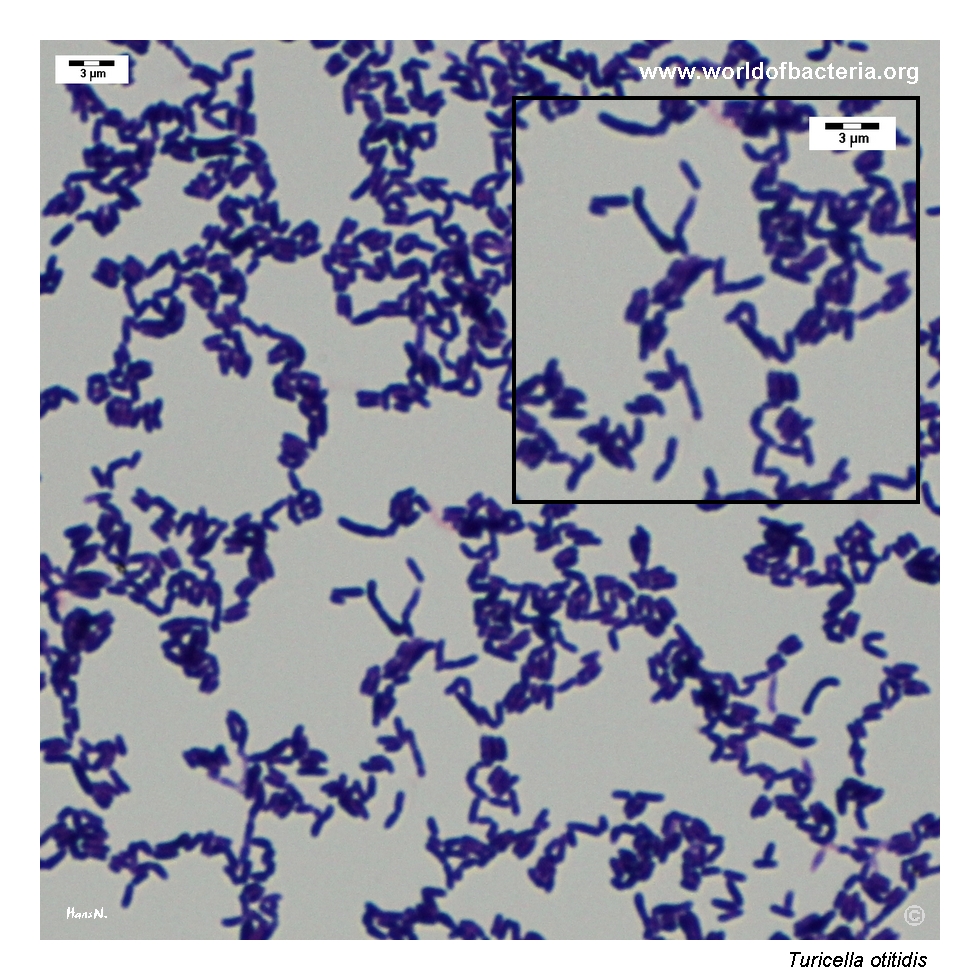
Gram-positive coryneform rods typical of the corynebacterial group
In the Gram-stained smear, the cells fit well with the organism’s close taxonomic relationship to Corynebacterium
The microscopic appearance helps separate the isolate from Gram-positive cocci that may produce superficially similar white colonies on blood agar
As with other coryneform bacteria, morphology alone does not establish the species
Oxygen Relationship
Aerobic routine culture isolate that grows on standard blood agar under ordinary otic culture conditions
In this image set, growth is shown after 48 hours at 36 °C in 5% CO2, followed by a further 24 hours at room temperature
The main practical challenge is not poor growth per se, but recovery from mixed material in which more familiar organisms may dominate attention
Rapid Identification Tests
Morphology: Gram-positive coryneform rods
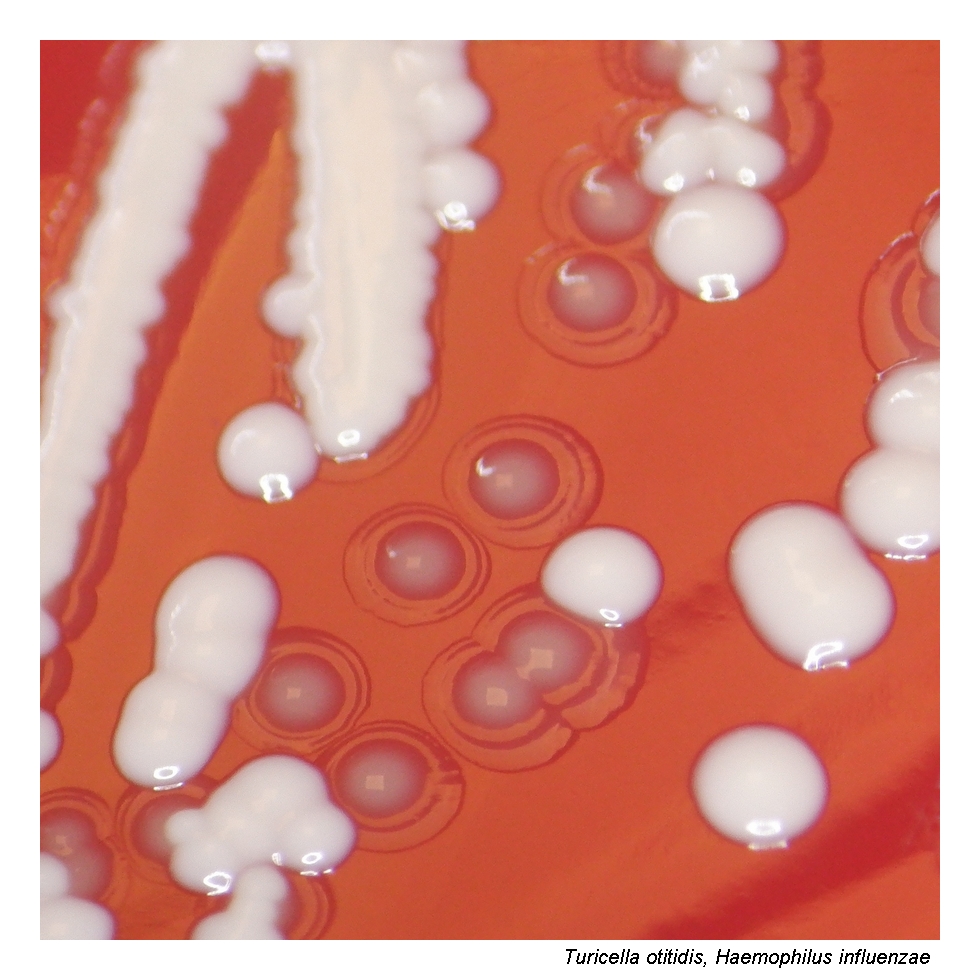
Colony phenotype: white, non-haemolytic, rather inconspicuous colonies that may resemble coagulase-negative staphylococci or other coryneform bacteria
Diagnostic context: typically encountered in ear-associated material and often mixed with other organisms
Taxonomic note: the organism has historically been known as Turicella otitidis, while current recommended medical nomenclature uses Corynebacterium otitidis
Useful next step: Gram staining followed by MALDI-TOF MS or another reliable modern identification method
Ecology and Clinical Relevance
Natural Habitat
Turicella otitidis is strongly associated with the human ear, especially the external auditory canal, and has also been detected in middle-ear material
Its role is difficult to interpret because the organism may behave as part of the local ear microbiota while also being repeatedly recovered from otitis-associated specimens
For practical laboratory purposes, it should be regarded as an ear-associated coryneform bacterium whose importance depends heavily on specimen type and culture context
Common Clinical Specimens
Paracentesis material and middle-ear exudates
External ear canal swabs and other otic specimens
Occasional mixed cultures in which the organism is accompanied by more established otopathogens
Clinical Significance
The clinical relevance of T. otitidis remains debated rather than fully resolved
It has often been recovered from otitis-related material, but it is also known from the external auditory canal of healthy individuals, which complicates interpretation
In the present page set, the main teaching value lies in showing how an ear-associated coryneform bacterium can persist in mixed culture and be overshadowed by more familiar pathogens such as Haemophilus influenzae
Differential Considerations
Haemophilus influenzae and other otitis-associated bacteria that dominate attention in mixed otic cultures
Coagulase-negative staphylococci and other white, non-haemolytic Gram-positive colonies on blood agar
Other coryneform bacteria recovered from upper respiratory or ear-associated material, especially species now placed in or near Corynebacterium
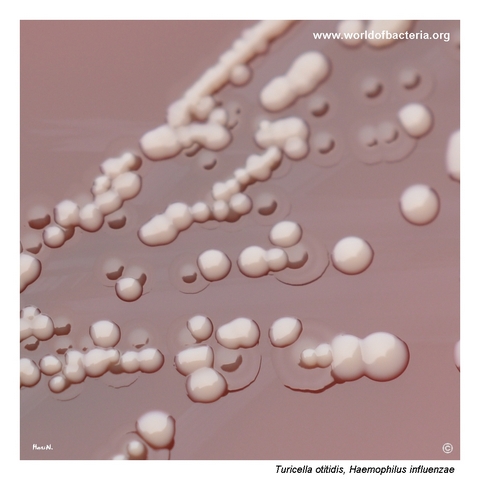
Two unsuccessful attempts to obtain a pure culture of Turicella otitidis. In both cases, colonies of T. otitidis remained mixed with Haemophilus influenzae. The specimen was pus obtained by paracentesis from a 20-year-old man with acute suppurative otitis media. Culture conditions: 48 hours at 36 °C in 5% CO2, followed by a further 24 hours at room temperature. Such mixed growth illustrates the practical difficulty of isolating slower-growing organisms from polymicrobial material.
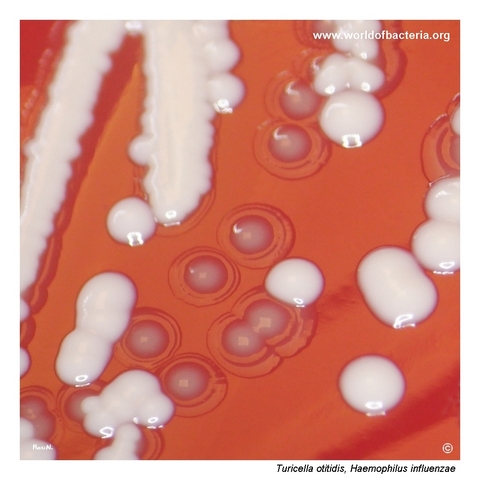
Colonies of Turicella otitidis and Haemophilus influenzae on blood agar. Colonies of T. otitidis are white, whereas the colonies of H. influenzae are non-pigmented. The image also demonstrates satellite growth of H. influenzae around colonies of another bacterial species. Culture conditions: 48 hours at 36 °C in 5% CO2, followed by 24 hours at room temperature. This interaction is a useful teaching example of how one organism may support the visible growth of another on routine medium.
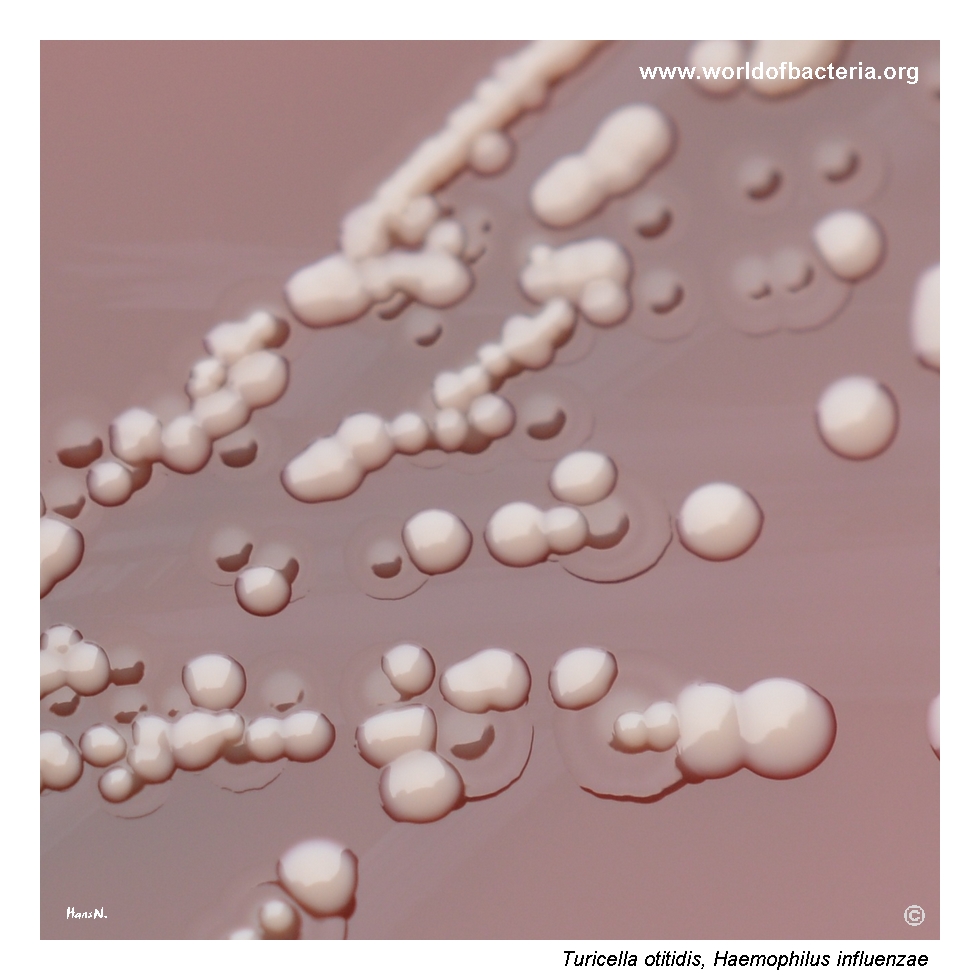
Close-up view of colonies of Turicella otitidis and Haemophilus influenzae on blood agar. In this case, T. otitidis forms white colonies resembling those of coagulase-negative staphylococci or other coryneform bacteria. Culture conditions: 48 hours at 36 °C in 5% CO2, followed by 24 hours at room temperature. This rather inconspicuous appearance is diagnostically important, because the organism may easily be overlooked in mixed culture if attention is focused mainly on more familiar pathogens.
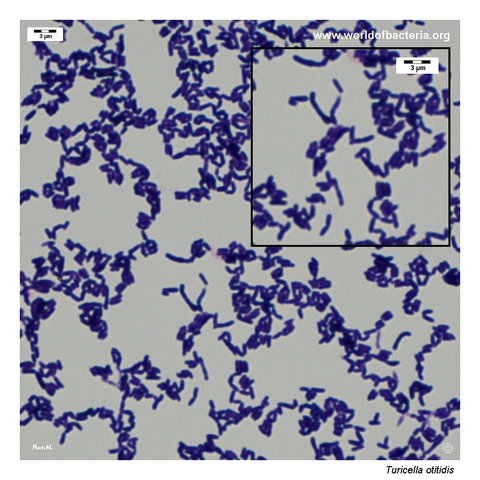
Gram-stained smear prepared from a colony of Turicella otitidis grown on blood agar. The organism appears as Gram-positive coryneform rods. The species is closely related to the genus Corynebacterium, and the name Corynebacterium otitidis has sometimes been used for this organism. The microscopic appearance therefore fits well with its taxonomic position and helps explain why the colonies may easily be mistaken for those of other coryneform bacteria during routine culture reading.
Diagnostic and Clinical Notes
This page is instructive because it shows how difficult it can be to recover an ear-associated coryneform bacterium from polymicrobial otic material. In both culture attempts, Turicella otitidis remained mixed with Haemophilus influenzae, which is a much more familiar otitis-associated organism and can easily dominate the reader’s attention.
The second image also adds a useful teaching point by illustrating satellite growth of H. influenzae around another bacterial species. Even when this interaction is appreciated, however, the white colonies of T. otitidis remain visually modest and could easily be dismissed as background flora or as another ordinary coryneform isolate.
Clinically, interpretation of T. otitidis remains cautious. The organism has repeatedly been recovered from middle-ear specimens, yet it is also known from the external auditory canal, so its precise role in otitis has long been debated. For this reason, culture context, specimen quality, abundance, and the presence of better-established otopathogens all matter when judging significance.
A further point of interest is nomenclature. Historically this bacterium has been known as Turicella otitidis, but current recommended medical nomenclature places it as Corynebacterium otitidis. For an atlas page, both names are worth recognizing because both still appear in the literature and in laboratory communication.
Laboratory Identification
Colony Morphology
On blood agar, Turicella otitidis forms white, non-haemolytic, rather inconspicuous colonies that may resemble coagulase-negative staphylococci or other coryneform bacteria. In the present material, the organism remains mixed with Haemophilus influenzae, which makes the plate reading more challenging than the appearance of the colonies alone would suggest.
Microscopy
Gram staining shows Gram-positive coryneform rods. This microscopic appearance is fully compatible with the organism’s close relationship to Corynebacterium and is an important corrective when the colonies might otherwise be mistaken for those of small Gram-positive cocci or dismissed as nonspecific background flora.
Key Identification Clues
White non-haemolytic colonies in ear-associated mixed culture
Recovery from paracentesis material or other otic specimens
Gram-positive coryneform rods rather than true cocci on smear
Potential to be overlooked when mixed with Haemophilus influenzae or other more familiar otopathogens
Current nomenclatural overlap between Turicella otitidis and Corynebacterium otitidis
Modern Identification Methods
Reliable identification is best achieved by MALDI-TOF mass spectrometry when the database is sufficiently current, or by other dependable modern identification methods when needed. This is especially important for T. otitidis because the organism is uncommon in routine work, easy to overlook in mixed culture, and subject to nomenclatural ambiguity in the literature and databases.
Antibiotic Characteristics
No simple therapeutic rule should be inferred from the appearance of the colonies alone. The main value of this page is diagnostic rather than susceptibility-based.
Because the organism is usually encountered in ear-associated mixed cultures and its exact pathogenic role may be uncertain, treatment decisions should be guided by the broader clinical picture, the presence of co-isolated pathogens, and formal susceptibility testing when the isolate is considered clinically relevant.
The most important practical message is that an apparently modest white colony in otic material may still deserve accurate species identification, especially when routine interpretation is being driven mainly by more conspicuous accompanying organisms.
Note: In current recommended nomenclature for bacteria of medical importance, this organism is placed as Corynebacterium otitidis, although the older name Turicella otitidis remains widely recognized in the clinical literature.