Clostridioides difficile is an obligately anaerobic spore-forming rod best known as the cause of antibiotic-associated diarrhoea and pseudomembranous colitis, with irregular colonies that often become recognizable to experienced laboratories by their coarse surface and characteristic odour.
Basic Characteristics
Taxonomy
Domain: Bacteria
Phylum: Bacillota
Class: Clostridia
Order: Eubacteriales
Family: Peptostreptococcaceae
Genus:Clostridioides
Species:Clostridioides difficile
Microscopy & Gram Stain
Gram-positive anaerobic rods with variable length and width depending on culture age and growth conditions
Subterminal spores may be visible in some cells and are an important morphological clue
Older or degenerating cells may stain Gram-negative, producing partial Gram variability in ageing cultures
The page set shown here illustrates both the typical rod morphology and the interpretative caution needed when older anaerobic cultures are examined microscopically
Oxygen Relationship
Obligate anaerobe
Grows best under strict anaerobic conditions and is typically cultured on selective or supportive anaerobic media
The images on this page were produced on Schaedler agar under an anaerobic atmosphere of 80% N2, 10% CO2, and 10% H2
In routine diagnostics, the organism is usually considered in the context of intestinal disease rather than as a general wound or blood culture anaerobe
Rapid Identification Tests
Colony odour: mature colonies often develop the characteristic horse-stable smell associated with p-cresol production
Spore formation: spore-bearing rods support recognition of the organism on microscopy
Toxin detection: demonstration of toxin A, toxin B, or toxin genes is central to the diagnosis of clinically significant intestinal infection
Modern identification: MALDI-TOF MS and validated anaerobe workflows are appropriate for species confirmation from culture
Ecology and Clinical Relevance
Natural Habitat
Clostridioides difficile is associated mainly with the intestinal tract of humans and animals and with spore-contaminated healthcare environments
Its spores persist well in the environment and are a major reason why transmission in healthcare facilities can be difficult to control
For atlas purposes, the species is especially important as a classical example of an anaerobic intestinal pathogen with distinctive colonies on suitable medium
Common Clinical Specimens
Stool from patients with suspected antibiotic-associated diarrhoea or pseudomembranous colitis
Anaerobic culture material used for toxin-producing strain demonstration or laboratory teaching
Occasionally research, reference, or teaching isolates grown on Schaedler agar or related anaerobic media
Clinical Significance
Clostridioides difficile is one of the most important causes of healthcare-associated infectious diarrhoea and colitis
Clinically significant disease is linked mainly to toxin production, especially toxin A and toxin B
The organism is highly relevant in antibiotic-associated intestinal disease, but asymptomatic carriage and colonization also occur, so microbiological findings must be interpreted in proper clinical context
Differential Considerations
Other anaerobic Gram-positive rods recovered on similar media
Other irregular colony-forming anaerobes where odour, surface texture, and microscopy may overlap
Non-toxigenic Clostridioides difficile strains versus toxin-producing strains
Intestinal pathogens or colonizing anaerobes where culture morphology alone is insufficient for clinical interpretation
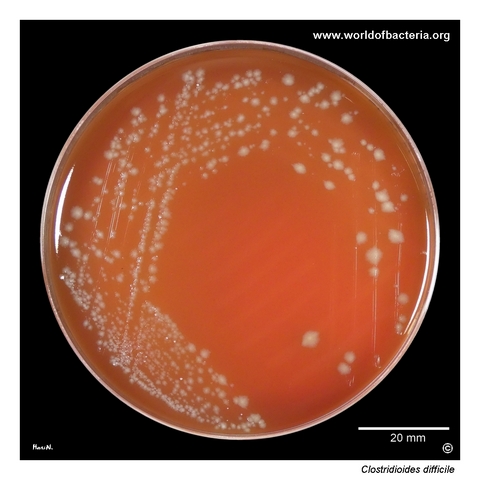
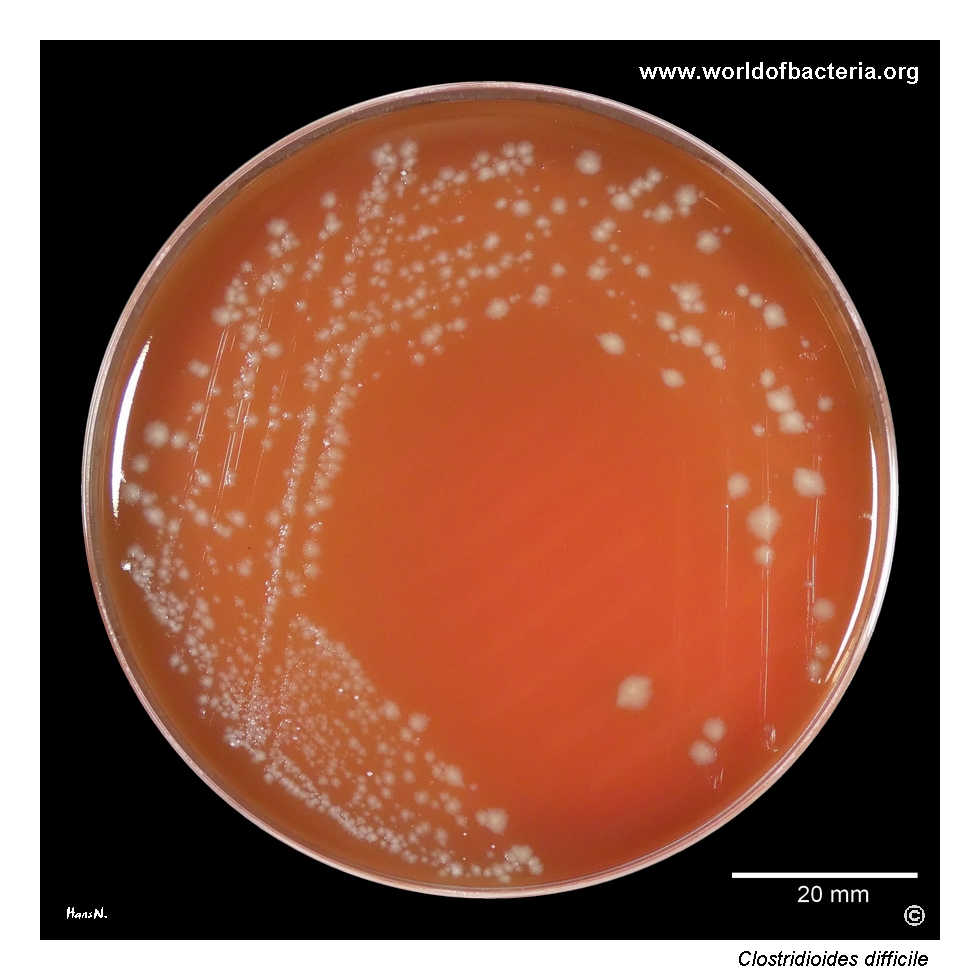
Clostridioides difficile on Schaedler agar after 48 hours of incubation at 36 °C under anaerobic conditions (80% N2, 10% CO2, 10% H2). The culture shows a mixture of small to medium-sized colonies, mostly irregular in shape, often elongated along the direction of the inoculation streaks. Colony colour varies between isolates and is usually described as cream-yellow to grey-white. This variability is typical and should be taken into account during routine culture reading.
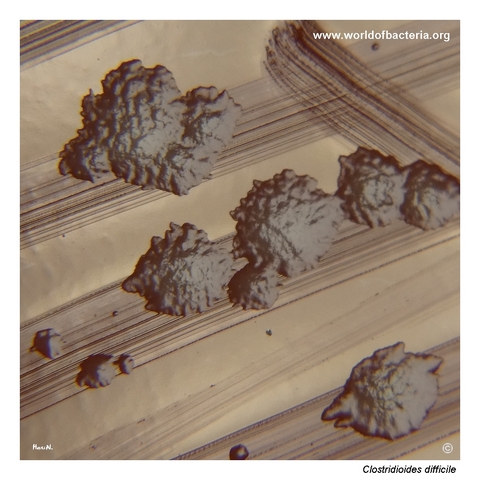
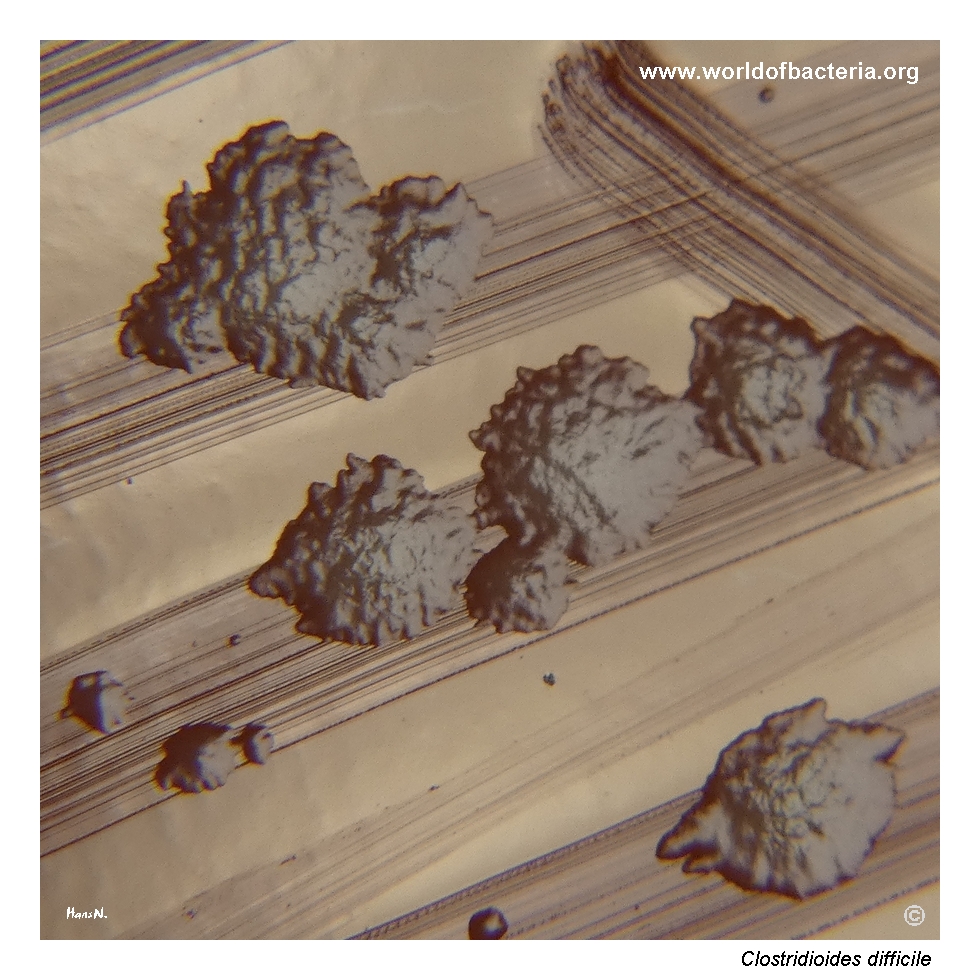
Colonies of Clostridioides difficile photographed in reflected light. The colonies are irregular, coarse, and matt, with a mottled to mosaic-like internal structure. A characteristic horse-stable odour caused by p-cresol production is associated with the species and is well known in anaerobic bacteriology. Together, the unusual surface texture and distinctive smell make mature colonies of C. difficile quite recognizable to experienced laboratory workers.
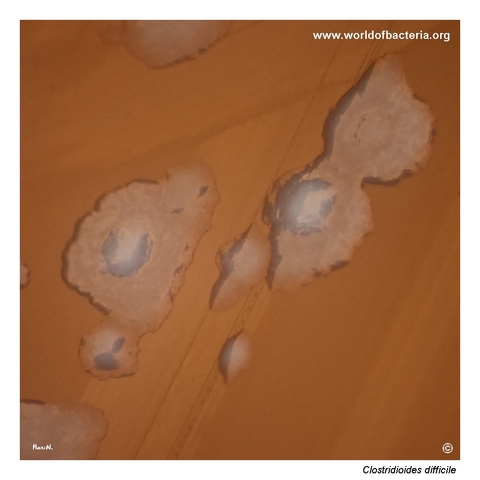
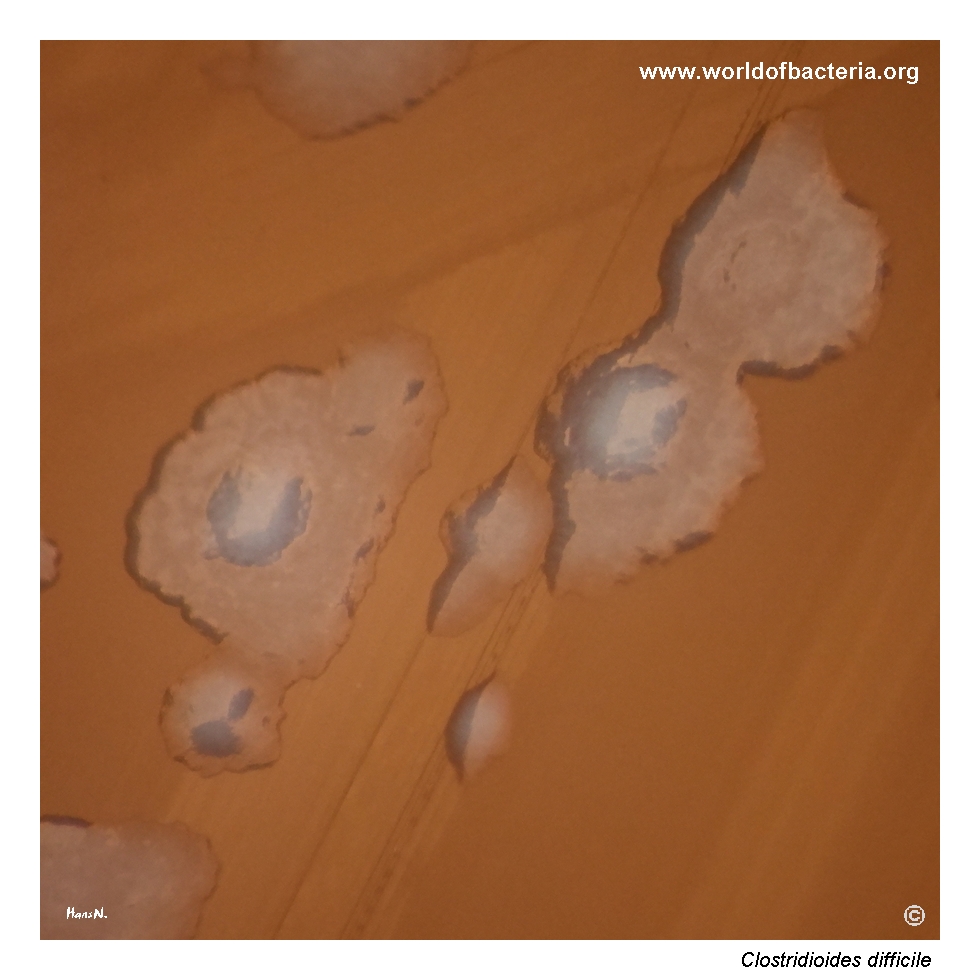
Close-up view of Clostridioides difficile colonies from a different strain than in the previous image. The colonies are again irregular in shape, but in this case the surface is noticeably smoother. Schaedler agar, 48 hours, 36 °C, anaerobic atmosphere. This strain produces both toxin A and toxin B, the two major virulence factors classically associated with the pathogenic potential of C. difficile in intestinal infection.
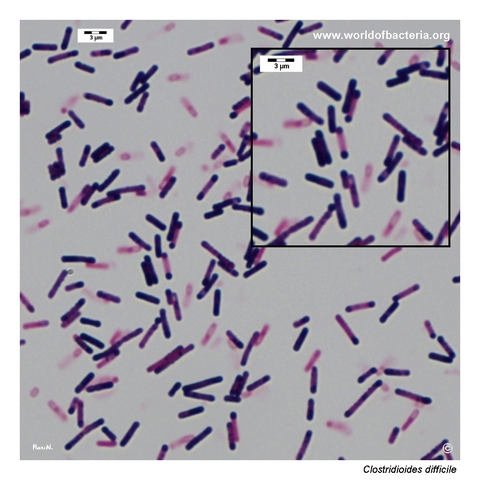
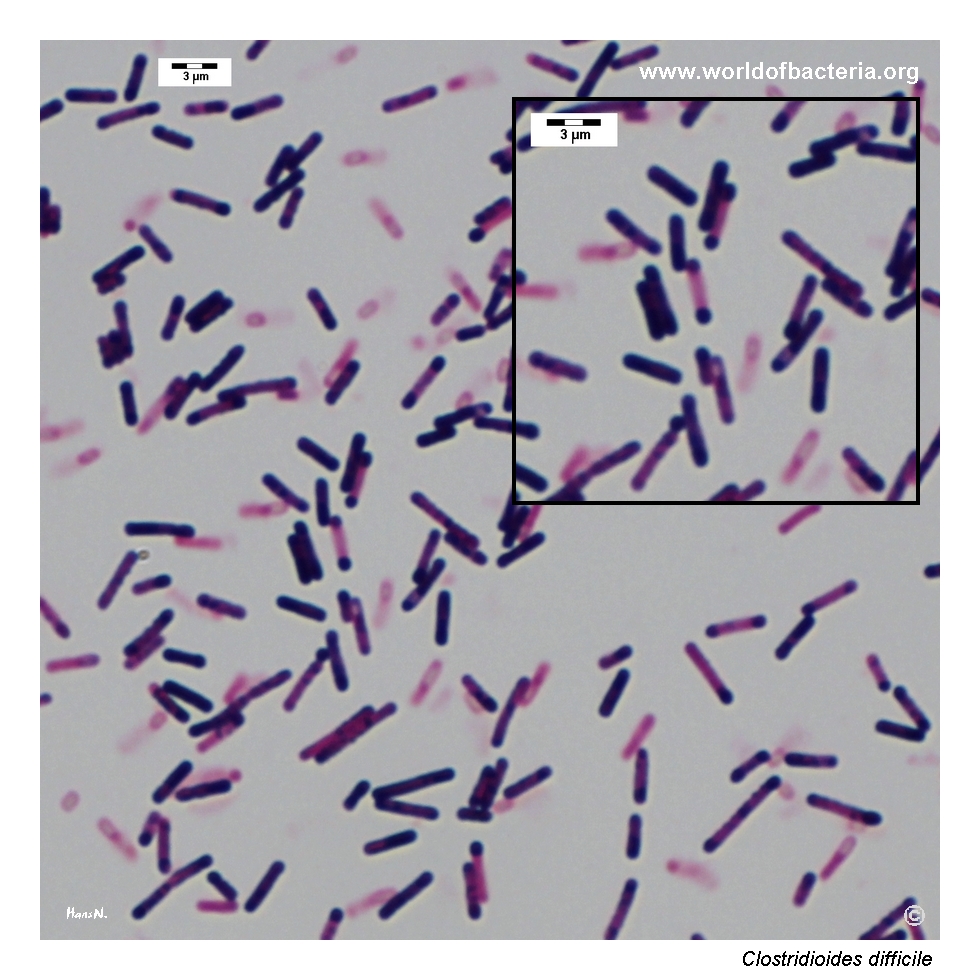
Gram-stained smear prepared from a colony of Clostridioides difficile grown on Schaedler agar. The organism appears as Gram-positive rods, with subterminal spores visible in some cells. Older or degenerating cells may lose their Gram positivity and stain Gram-negative. This partial Gram variability is not unusual in ageing cultures and should be interpreted with caution when evaluating the microscopic appearance of anaerobic isolates.
Diagnostic and Clinical Notes
This page is especially useful because it shows how variable the colony appearance of Clostridioides difficile can be even within a narrow time window of routine anaerobic culture. The first and third images together make it clear that not all strains present exactly the same surface texture or degree of irregularity.
The second image captures one of the most memorable classic teaching points in anaerobic bacteriology: mature colonies of C. difficile often combine a coarse matt surface with a characteristic odour caused by p-cresol production. This is not a formal identification test on its own, but it is a strong practical clue for experienced readers.
The third image adds an important pathogenic perspective by showing a strain known to produce both toxin A and toxin B. For this species, cultural recognition and clinical relevance cannot be separated from toxigenicity.
The Gram stain completes the picture by demonstrating rod-shaped cells with subterminal spores and the partial Gram variability that may appear in older cultures. This is a good reminder that microscopy from ageing anaerobic colonies can be misleading if interpreted too rigidly.
Overall, the page works well didactically because it links culture morphology, microscopy, odour, and toxin biology into one coherent laboratory phenotype.
Laboratory Identification
Colony Morphology
On supportive anaerobic media such as Schaedler agar, Clostridioides difficile forms small to medium-sized colonies that are typically irregular, often elongated along the direction of inoculation, and variably cream-yellow to grey-white. Mature colonies may look coarse, matt, and mosaic-like, although smoother variants can also occur.
Microscopy
The Gram-stained smear shows Gram-positive rods with subterminal spores, which is highly compatible with the species. At the same time, older cells may appear partially Gram-variable or even Gram-negative. This means that microscopy is informative but should always be interpreted alongside the anaerobic growth pattern and overall colony phenotype.
Key Identification Clues
Obligate anaerobic growth on suitable media
Irregular coarse colonies that may become quite recognizable after 48 hours
Characteristic horse-stable odour linked to p-cresol production
Gram-positive rods with subterminal spores
Clinical context of antibiotic-associated diarrhoea or colitis
Need to distinguish toxin-producing strains from non-toxigenic isolates
Modern Identification Methods
Species confirmation can be achieved with MALDI-TOF MS or other validated anaerobe identification workflows. However, clinically meaningful interpretation of C. difficile also depends on toxin testing or toxin-gene detection, because disease is driven mainly by toxigenicity rather than by the mere presence of the organism.
Antibiotic Characteristics
No treatment inference should be made from colony appearance alone. In Clostridioides difficile, the central clinical issue is not just species identification but the relationship between toxin production, symptoms, and the patient’s broader antibiotic and healthcare exposure history.
For this atlas page, the main educational emphasis is on phenotypic recognition: obligate anaerobic growth, irregular colonies, the classic odour, and the spore-bearing Gram-positive rods.
Note: The presence of C. difficile in culture does not by itself prove active toxin-mediated disease; laboratory findings must be interpreted with appropriate clinical and toxin-based correlation.